01
Flowering
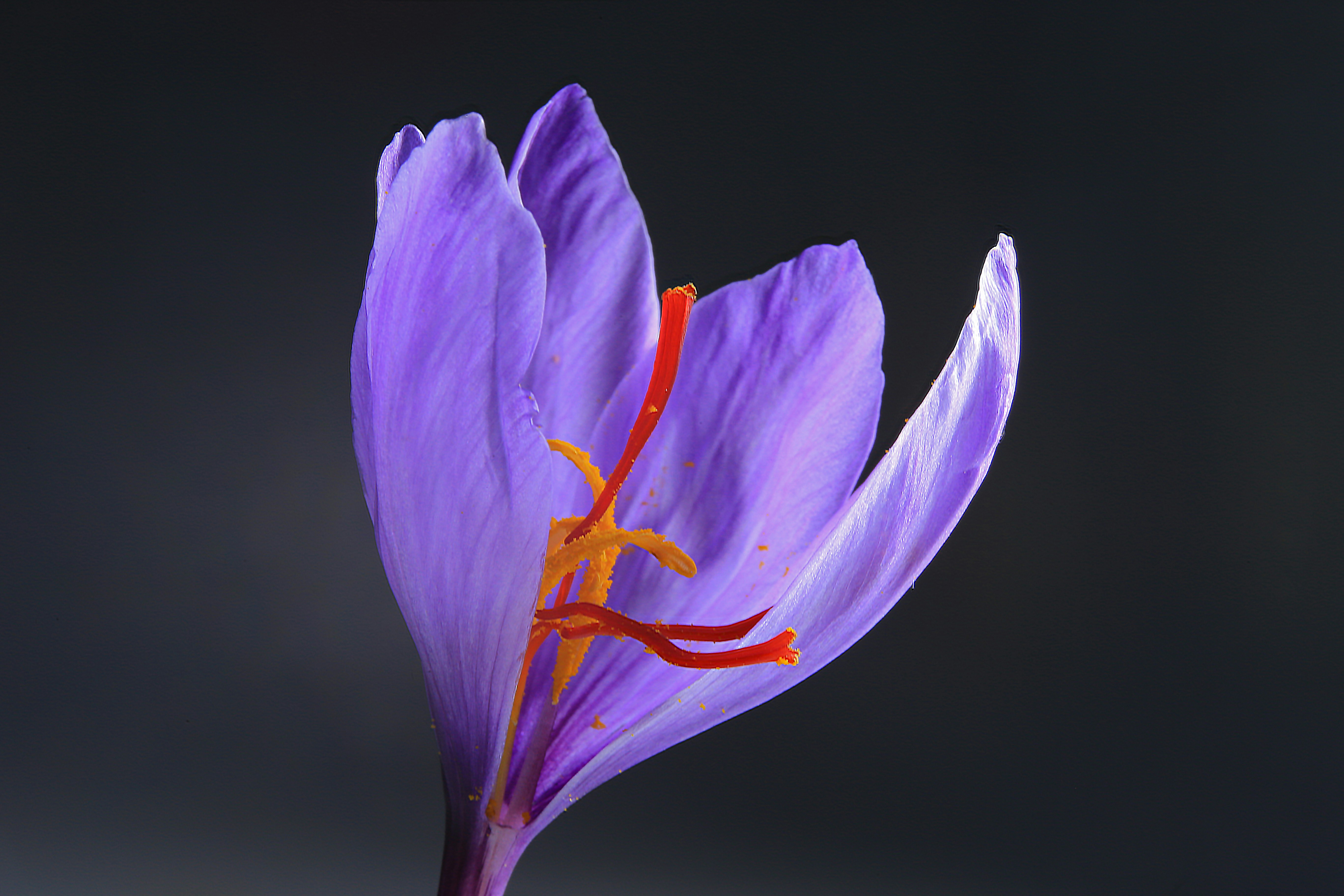
The Crocus sativus flowers bloom for a short period during autumn.
A Herb Heaven guide
Saffron, known locally as Kesar, is one of the world's most precious spices. Each delicate red thread is the dried stigma of the Crocus sativus flower — and every flower produces only three.
In Kashmir, saffron has been cultivated for generations across the saffron-growing belt of Pampore and surrounding areas of Pulwama, as well as other parts of the region. Kashmir Saffron holds Geographical Indication (GI) registration in India, recognising its origin and distinctive character. What makes it special isn't just colour — it's the combination of deep natural colour, characteristic aroma, distinctive flavour and the traditional care behind every thread.
Where it comes from
The Crocus sativus plant blooms for a short period each autumn, creating a brief, highly labour-intensive harvest. Pampore is widely known as the heartland of Kashmir's saffron cultivation, though saffron also grows in other parts of Jammu & Kashmir, including Kishtwar. The flowers are traditionally picked by hand, and their three red stigmas carefully separated and dried.
Kashmir's high altitude, cool climate, seasonal temperature swings, soil conditions and traditional cultivation practices all contribute to what makes Kashmiri saffron distinctive.
What makes it unique
The quality and character of saffron are shaped by geography, soil, climate, harvesting time, drying and storage. Three naturally occurring compounds give Kashmiri saffron its defining sensory qualities.
A carotenoid compound responsible for saffron's intense golden-yellow colouring when infused.
The compound behind saffron's characteristic bitter taste and much of its flavour.
A volatile compound that contributes strongly to saffron's distinctive, complex fragrance.
From flower to saffron
The journey from field to finished thread is remarkably labour-intensive — and every step is done by hand.
The Crocus sativus flowers bloom for a short period during autumn.
Flowers are carefully collected, traditionally by hand.
Each flower's three red stigmas are delicately separated from the petals.
Fresh stigmas are carefully dried to develop their characteristic colour, aroma and flavour.
Dried threads are sorted according to their form and quality.
The finished saffron is protected from moisture, heat, light and strong external aromas.
Understanding saffron types
Kashmiri saffron is commonly described by the form and portion of the stigma. A name or appearance alone can't establish authenticity or quality — laboratory parameters are far more reliable — but understanding the terms helps you know what you're buying.
The premium red stigma form
Predominantly the deep red stigma without the yellow style attached — commonly regarded as the premium form.
Red stigmas with some yellow style
Still excellent saffron — it simply retains more of the yellowish style than Mongra.
Traditionally bundled saffron
The traditional bundled presentation — the term alone doesn't guarantee a particular quality grade.
What quality really means
Professional assessment looks at measurable characteristics. Indian food standards specify limits for moisture, extraneous matter and floral waste, and minimum values for colouring strength and picrocrocin, plus a defined range for safranal.
Inside a saffron thread
Saffron contains carotenoids, volatile compounds, flavonoids, proteins, sugars and minerals — along with crocetin and other phytochemicals. Three compounds do most of the work.
The carotenoid responsible for saffron's characteristic colour when extracted.
A naturally occurring compound behind much of saffron's distinctive bitterness.
The volatile compound that contributes strongly to saffron's distinctive scent.
How to use it
A few threads can transform an entire preparation — saffron contributes colour, flavour and aroma all at once.
Infuse threads with traditional kehwa ingredients for an aromatic golden cup.
Add saffron-infused water or milk for colour and fragrance.
Use in kheer, phirni, custards, cakes and ice creams.
Infuse a small quantity in warm milk for a traditional preparation.
Works beautifully in sauces, gravies, rice and meat preparations.
Gently crush or steep threads in warm water or milk before adding, so flavour develops gradually.
Saffron & wellness
Modern research has investigated saffron's bioactive compounds — particularly crocin, crocetin, picrocrocin and safranal — for antioxidant and anti-inflammatory activity, and human studies have looked at mood, cognitive function and other areas. Evidence varies by condition, dose and preparation.
Crocin and crocetin have shown antioxidant activity in experimental research.
Clinical research has explored saffron extracts for mood, with promising early findings.
Crocin, crocetin and safranal have been investigated for possible neuroprotective effects.
Checking authenticity
No home test proves authenticity with certainty — laboratory testing is the reliable way to confirm identity, purity and quality. But these checks can help you spot something suspicious.
Place a few threads in warm water. Genuine saffron gradually releases a golden-yellow to yellow-orange infusion while the threads keep much of their reddish colour.
Be cautious if colour bleeds out immediately and intensely.
Genuine stigmas are naturally irregular, deep red, and typically broaden or trumpet toward one end — not perfectly uniform like manufactured fibres.
Rub a few threads between clean fingers. Authentic saffron has a complex aroma — hay-like, floral, earthy, slightly sweet — from safranal.
A tiny amount on the tongue should show noticeable bitterness, from picrocrocin. Avoid swallowing large quantities just to test.
Different saffron and adulterants behave differently when heated — we don't recommend burning as a reliable consumer test.
Storing saffron
Keep it in a properly sealed container.
Sunlight can degrade quality over time.
Moisture encourages deterioration.
Saffron absorbs surrounding smells.
Avoid unnecessary heat exposure.
The Herb Heaven saffron promise
We believe premium saffron shouldn't need exaggerated claims — it should speak for itself through appearance, aroma, colour and flavour. From the fields of Kashmir to your kitchen, every thread carries a story of place, season and painstaking human work. That's why Herb Heaven chooses whole threads: so you can see exactly what you're buying.
Explore our saffron collection →